
Macau Travel Guide for First-Timers: Entry, the Historic Centre and Food
Policy last verified: 2026-11-10
Key facts
- Macau has its own immigration rules, separate from both Hong Kong and mainland China. The Macau government lists visa-free stays of 30 days for US, Canadian and Australian citizens, 90 days for EU and Schengen citizens and six months for British citizens.
- Your passport must be valid for at least 90 days beyond your stay, and you may be asked for an onward or return ticket.
- From Hong Kong, take a ferry from Sheung Wan to the Outer Harbour or Taipa, or the 24-hour shuttle bus over the Hong Kong–Zhuhai–Macao Bridge. From Zhuhai, cross at Hengqin (24 hours) or the Border Gate.
- The Historic Centre of Macau, on UNESCO's World Heritage List since 2005, is best seen on foot: Senado Square, the Ruins of St Paul's, Mount Fortress, Guia Fortress and A-Ma Temple.
- Eat Macanese food, a mix of Portuguese and Chinese cooking: try African chicken, minchi, Portuguese egg tarts, serradura and a pork chop bun.
- If you're using 240-hour transit on the mainland, Macau counts as a separate region. Enter the mainland at Hengqin, which is a listed port; the Border Gate (Gongbei) is not.
Short answer: Macau is a small city on the south China coast, a short ferry or bus ride from Hong Kong, with its own entry rules, separate from both Hong Kong and mainland China. Many Western passport holders can visit without a visa. Come for the Historic Centre of Macau, a UNESCO World Heritage site where Portuguese churches and squares stand next to Chinese temples and mansions, and for Macanese food, which mixes Portuguese and Chinese cooking. Most first visits need one or two nights. From here it's a short hop to Zhuhai on the mainland, through Hengqin Port, or back to Hong Kong over the Hong Kong–Zhuhai–Macao Bridge.
This page is our starting point for Macau. For the cities on either side, see our Hong Kong city guide and Zhuhai city guide. To combine all three, follow Hong Kong, Macau and Zhuhai in 3 days.
Before you go: entry to Macau
Macau is a Special Administrative Region of China, and like Hong Kong it runs its own immigration controls. A mainland China visa, or mainland visa-free entry, doesn't cover Macau. A Hong Kong entry doesn't cover it either. You'll go through immigration every time you cross between Macau, Hong Kong and the mainland.
According to the Macau government's list, checked on 10 November 2026:
- US, Canadian and Australian citizens, and most other visa-exempt nationalities, can stay for up to 30 days without a visa.
- Citizens of EU and Schengen countries can stay for up to 90 days.
- New Zealand citizens can stay for up to three months.
- British citizens on a British passport can stay for up to six months.
Some other nationalities can get an entry permit on arrival at the border, and a few must apply for a visa in advance. Whatever your passport, the government lists these conditions:
- Your passport must be valid for at least 90 days beyond your stay.
- You may be asked for an onward or return ticket.
- You may be asked to show you have enough money for your stay.
Check the list for your own passport before you book. We explain public rules only; we don't arrange visas.
Macau, Hong Kong and the mainland's 240-hour rule
If Macau is one stop on a longer trip that includes mainland China, plan your entry basis for the mainland separately. You need 30-day visa-free entry, 240-hour visa-free transit or a visa.
- Macau is a separate region. For the 240-hour rule, Hong Kong, Macau and Taiwan count as separate from the mainland. You can arrive in Macau, enter the mainland, and then fly from Guangzhou or Shenzhen to a third country. You can also arrive on the mainland from abroad and leave for Macau.
- A round trip doesn't qualify. Macau → mainland → Macau doesn't count as transit, because you'd be returning to the region you came from. For that kind of trip you need 30-day visa-free entry or a visa.
- Use a listed port. From Macau, the listed land crossing is Hengqin Port. The Border Gate crossing to Gongbei is not on the 240-hour entry list, and nor is Qingmao. You can leave the mainland through any open Guangdong port, including the Hong Kong–Zhuhai–Macao Bridge.
- Loops that start and end in Hong Kong, such as Hong Kong → Macau → Zhuhai → Hong Kong, are less clear-cut. Confirm with the national immigration hotline on 12367 (+86 12367 from abroad) before you rely on 240-hour transit for one.
The 30-day visa-free list covers 50 countries, including the UK, Canada, Australia, New Zealand and most of the EU; for 48 of them it currently runs until 31 December 2026. The US is not on that list. We track the latest on our 30-day visa-free expiry page.
Read our 240-hour visa-free transit guide, or run your route through the 240-hour checker.
Getting to Macau
From Hong Kong by ferry. Ferries leave the Hong Kong–Macao Ferry Terminal in the Shun Tak Centre, Sheung Wan, and arrive at Macau's Outer Harbour Ferry Terminal on the peninsula or the Taipa Ferry Terminal near the airport. Check which terminal your sailing uses, because they're on opposite sides of the city. The Outer Harbour is better if you're staying near the old town. Both terminals' immigration checkpoints are open 24 hours.
From Hong Kong over the bridge. Shuttle buses run between the bridge's Hong Kong Port, next to Hong Kong International Airport, and the Macau Port on the bridge's artificial island 24 hours a day. They leave about every 5 minutes at peak times and every 15 to 30 minutes overnight. Buy tickets in the departure hall or online. From the Macau Port, public buses and taxis run into the city; the Transport Bureau lists the current routes on its bridge page. Some cross-boundary coaches also run from urban Hong Kong to hotels in Taipa, and passengers with a valid flight ticket can use transfer coaches from Hong Kong airport via the bridge. If you're flying into Hong Kong, the bridge is often the quickest way to Macau. Our Hong Kong–Zhuhai–Macao Bridge guide covers tickets, hours and how the Macau and Zhuhai ports differ.
From Zhuhai. Three crossings link Macau with Zhuhai on the mainland:
- Hengqin Port is open 24 hours. Macau's LRT Hengqin Line runs from Lotus Station to the Macau side of the port in about 2 minutes, roughly every 6 minutes. Macau departure and mainland arrival are handled in the same building. Hengqin is a 240-hour entry port.
- The Border Gate (Portas do Cerco), on the north edge of the peninsula, faces Gongbei in Zhuhai. Macau police list it as open 06:00 to 01:00. It's the busiest crossing and a short walk from Zhuhai railway station, but it isn't a 240-hour entry port.
- Qingmao Port is open 24 hours, but Macau police say it's only for eligible residents of the mainland, Hong Kong and Macau. Foreign tourists should use Hengqin or the Border Gate.
There's also a Zhuhai–Macau passenger hall at the bridge's ports, which Macau police list as open 08:00 to 22:00.
By air. Macau International Airport is on Taipa, next to the Taipa Ferry Terminal, with its own LRT station.
The districts at a glance
Macau is small: the peninsula is walkable, and the rest of the city sits on reclaimed land to the south.
- The Macau peninsula. The old town and almost all of the World Heritage sites, from Senado Square and the Ruins of St Paul's in the middle to A-Ma Temple at the southern tip and Guia Fortress on its hill. The Outer Harbour Ferry Terminal and the Border Gate are both here.
- Taipa. Linked to the peninsula by bridges. Taipa Village has narrow lanes of snack shops and Portuguese restaurants around Rua do Cunha, plus the colonial-era Taipa Houses along the old waterfront. The airport and Taipa Ferry Terminal are on its east side.
- Cotai. Reclaimed land between Taipa and Coloane, filled with large resort hotels. Lotus Station, for the LRT to Hengqin, is here.
- Coloane. The quiet southern end of Macau, with a small old village and green hills.
Where to stay: for a first visit, the peninsula near Senado Square puts the heritage walk on your doorstep and is close to the Outer Harbour ferries and the Border Gate. Taipa Village is a good second choice if you want quieter evenings and quick access to the airport, the Taipa ferries and the LRT to Hengqin.
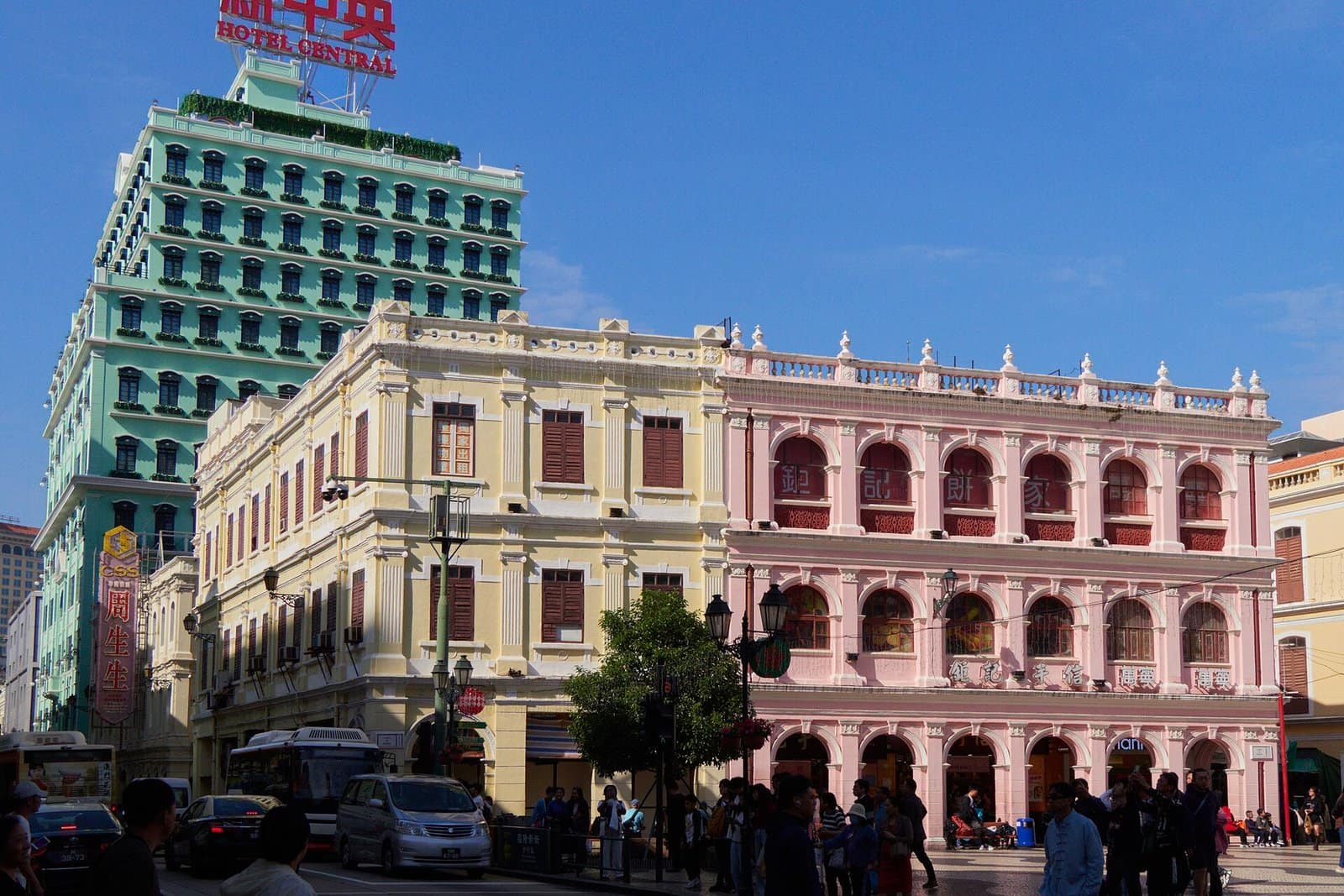 Photo: lumoplank / Wikimedia Commons, CC0 1.0

The Historic Centre of Macau
Macau was under Portuguese administration from the mid-16th century until 1999, when it returned to Chinese sovereignty. The Historic Centre of Macau has been on UNESCO's World Heritage List since 2005. UNESCO describes a group of 22 principal buildings and public spaces that show one of the earliest and longest-lasting meetings between China and the West: Chinese temples and Portuguese churches, squares and fortresses, and the oldest lighthouse in China. The squares are open around the clock; the buildings keep their own hours, listed below from Macau's Cultural Affairs Bureau as of 10 November 2026.
Senado Square and around. The wave-patterned square at the heart of the old town is open 24 hours and is the easiest place to start. Around it are the Leal Senado Building (09:00–21:00), the Holy House of Mercy, St Dominic's Church (10:00–18:00) and, a few minutes' walk up the hill, the Cathedral and Lou Kau Mansion, a Chinese merchant's house (10:00–18:00, closed on Mondays).
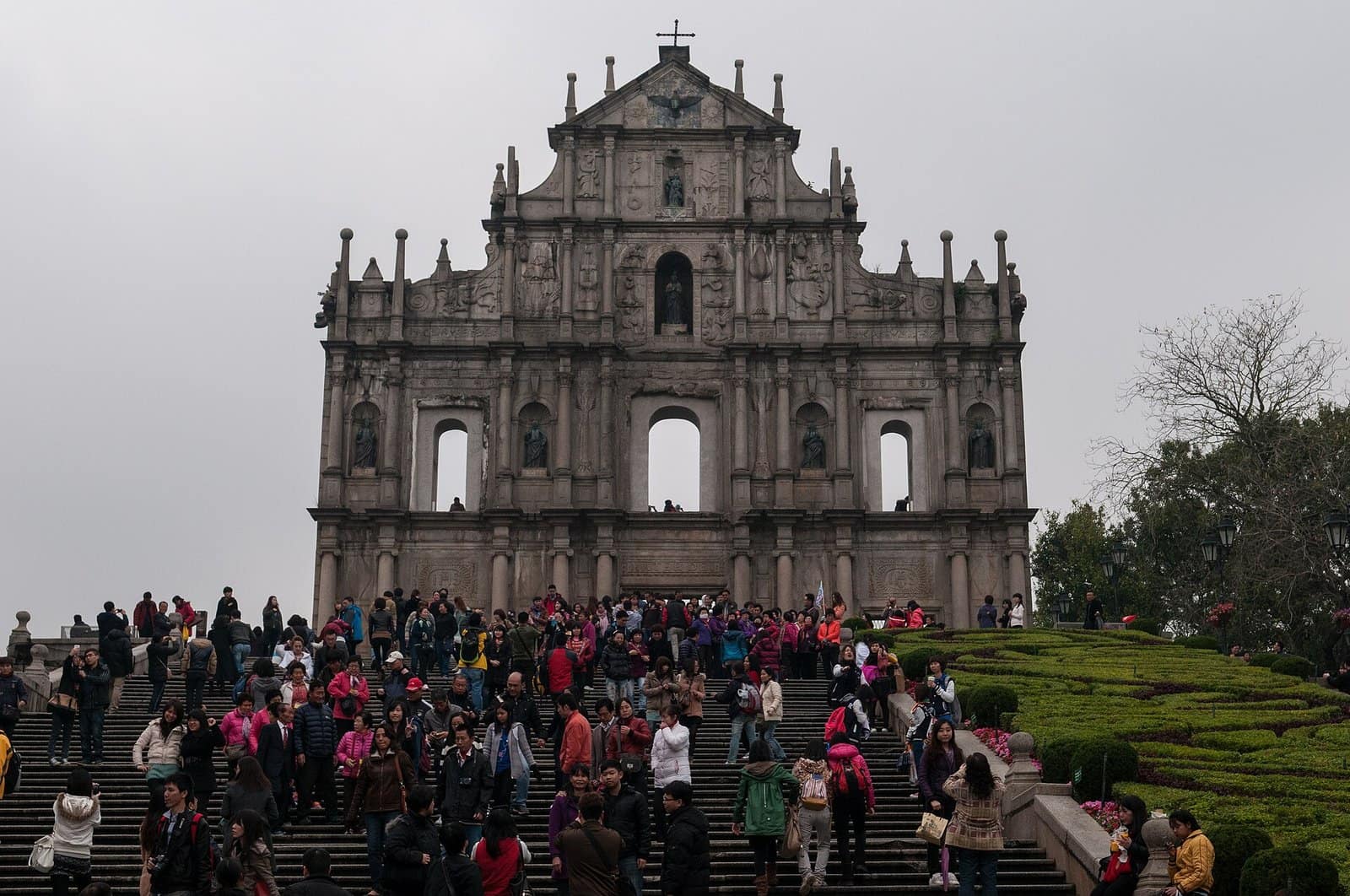
The Ruins of St Paul's. The stone façade of the Church of Mater Dei, built in 1602–1640 and destroyed by fire in 1835, is Macau's best-known landmark. UNESCO points out the Chinese characters carved among its baroque decorations. The façade can be seen at any time; the site behind it, with the crypt and a museum of sacred art, is open 09:00–18:00. Next door is the small Na Tcha Temple, built in 1888, and a surviving section of the old city walls.
Mount Fortress and the Macau Museum. Beside the ruins, the fortress and its gardens are open 07:00–19:00, with views over the old town. The city museum inside is open 10:00–18:00 and closed on Mondays.
Guia Fortress. On the peninsula's highest hill, the fortress is open 09:00–18:00 and its small chapel 10:00–17:00. The lighthouse itself, the oldest in China, isn't open to the public, but you can see it up close from the fortress grounds.
The southern walk to A-Ma Temple. Macau's tourism office suggests a walk through the older streets to the south and west: St Lawrence's Church, the Mandarin's House (the 19th-century home of writer Zheng Guanying; 10:00–18:00, closed on Wednesdays), Lilau Square, and A-Ma Temple (08:00–18:00), which existed before the city itself. On the way, Rua de Cinco de Outubro and the lanes near the Inner Harbour still have old shops and small eateries. Barra Station on the LRT is next to A-Ma Temple if you want to ride back.
Many of the heritage buildings are working churches and temples, so dress modestly and keep quiet during services.
Taipa Village
Taipa Village is the place to slow down. Macau's tourism office suggests a walk past the Taipa Houses, a row of restored Portuguese-era residences along Avenida da Praia; Our Lady of Carmel Church, built in 1885 on a hill above the old waterfront; the colourful lane of Calçada do Quartel; and the Pak Tai Temple and the Museum of Taipa and Coloane History. Rua do Cunha, the village's main lane, is lined with bakeries, snack shops and restaurants, and gets busy in the evenings and at weekends. The museums and the Taipa Houses keep their own opening days, so check before you go.
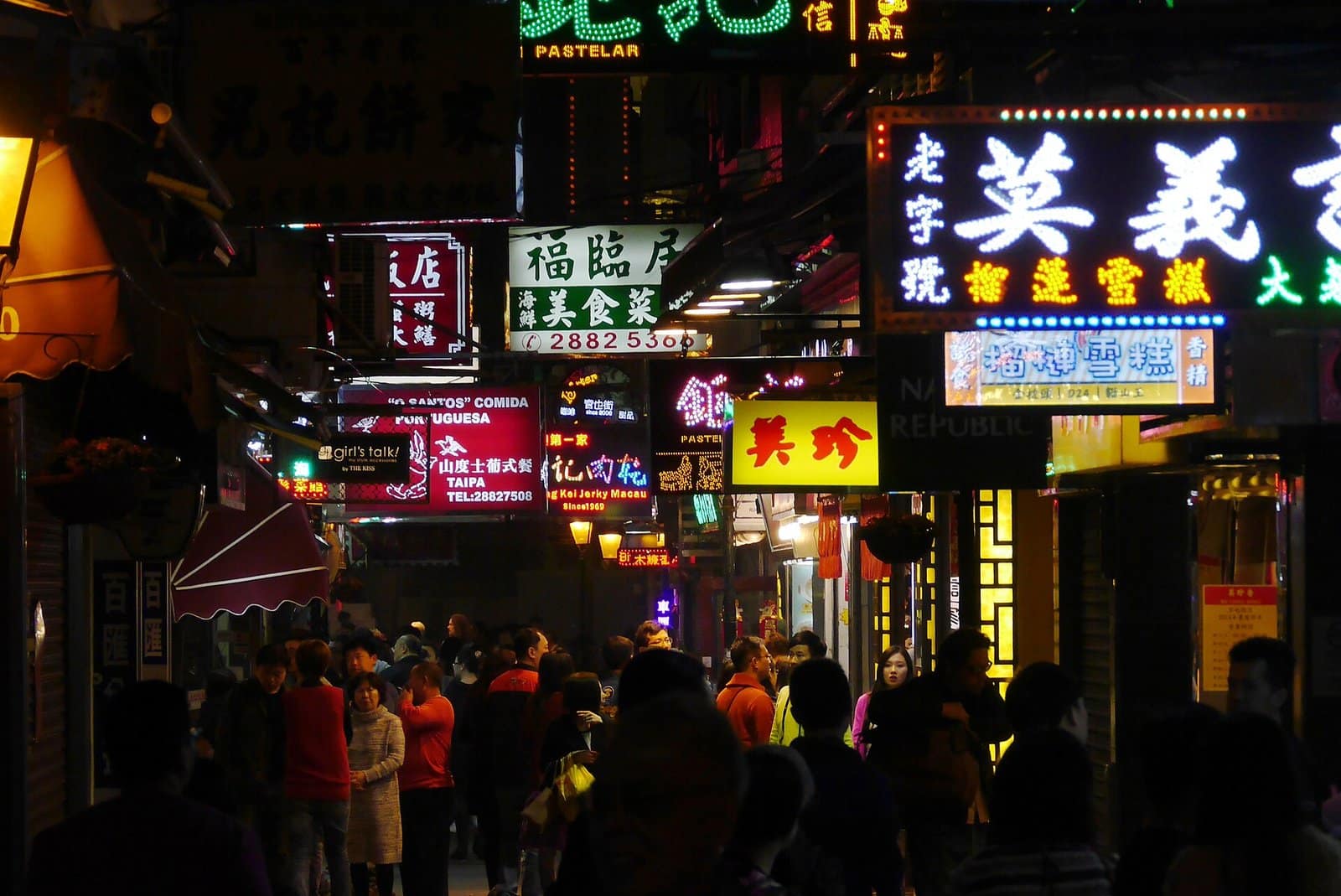 Photo: travel oriented / Wikimedia Commons, CC BY-SA 2.0

Food: Macanese cooking and street snacks
Food is the second reason to come. Macau has been a UNESCO Creative City of Gastronomy since 2017. Its own cuisine, Macanese, combines Portuguese and Chinese cooking with ingredients and seasonings from Europe, South America, Africa and Southeast Asia, brought by centuries of trade. You'll also find plain Portuguese restaurants and Cantonese food everywhere.
Macanese and Portuguese dishes to try, from the tourism office's list:
- African chicken: grilled chicken in a spicy piri piri or curry-style sauce.
- Minchi: minced meat fried with potatoes and onion, usually topped with an egg.
- Portuguese-style seafood rice, crab curry and bacalhau (salt cod) cooked several ways.
- Duck rice, baked with Portuguese sausage.
Desserts and snacks:
- Portuguese egg tarts (pastéis de nata): custard in flaky pastry with a caramelised top. Eat them warm.
- Serradura: whipped cream layered with biscuit crumbs.
- Pork chop bun: a grilled pork chop in a crusty bun, with nothing else.
- Almond cookies, beef jerky and egg puffs, which you'll see on sale around the Ruins of St Paul's and on Rua do Cunha.
- Wonton noodles and congee for breakfast, and spicy skewers along Travessa da Sé, near Senado Square.
A sit-down Macanese meal in the old town or Taipa Village is worth planning a day around.
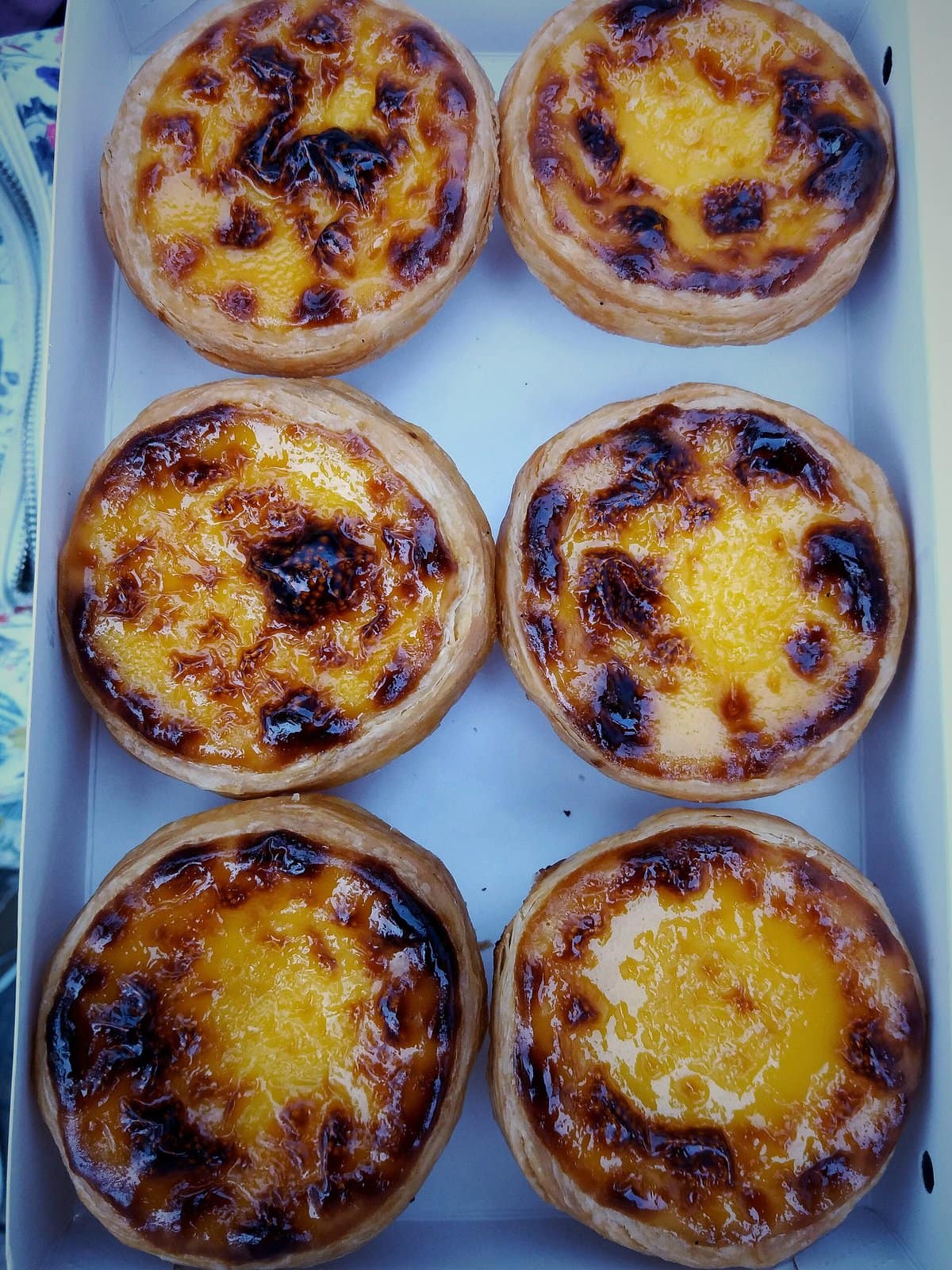 Photo: Pauloleong2002 / Wikimedia Commons, CC BY-SA 4.0

Getting around
On foot. The old town is compact, and walking is the best way to see it. Expect hills and steps between Senado Square, the Ruins of St Paul's and Mount Fortress.
Buses. Buses cover the whole city, including the ferry terminals, the Border Gate and the bridge's Macau Port. The cash box doesn't give change, so carry exact change in patacas. You can also pay with a Macau Pass stored-value card, and the Transport Bureau lists ride codes from the mainland and Hong Kong versions of Alipay and WeChat Pay as accepted. Visitor ride codes don't get the transfer discounts that Macau Pass users get.
The LRT. Macau's light rail has three lines. The Taipa Line runs from Barra, near A-Ma Temple on the peninsula, through Cotai and Taipa to the airport and Taipa Ferry Terminal, in about 28 minutes. The Hengqin Line runs from Lotus to Hengqin Port, and the short Seac Pai Van Line serves the Seac Pai Van area. Trains run 06:30–23:15 from Monday to Thursday and 06:30–23:59 from Friday to Sunday and on public holidays. Buy single tickets at stations or use a Macau Pass.
Taxis are metered and easy to find at ferry terminals, the airport and hotels. Carry the name of your destination in Chinese or Portuguese.
Paying and staying connected
Macau's currency is the pataca, which is pegged to the Hong Kong dollar, so the two are close in value. Shops in tourist areas often accept Hong Kong dollars, but you may get change in patacas. Macau's tourism office says Visa, Mastercard, UnionPay, American Express and JCB are widely accepted, and that merchants take a range of mobile wallets, including the mainland and Hong Kong versions of WeChat Pay and Alipay, Apple Pay and several overseas wallets. Card-issuing banks may charge fees. Keep some pataca cash for buses, small snack shops and LRT ticket machines. Patacas are hard to spend or exchange outside Macau, so don't change more than you need.
Mobile data. Macau is outside mainland China's internet controls, so your usual apps work here. Prepaid SIM cards are sold in convenience stores, and free public Wi-Fi is available as FreeWiFi.MO. Plan your data for any mainland leg separately; our eSIM guide for Hong Kong, Macau and mainland China compares plans that cover more than one market, and our paying and staying connected guide explains payments and data on the mainland.
How long to stay and how to plan your days
A day trip from Hong Kong. Possible, and common. Take an early ferry to the Outer Harbour, walk from Senado Square to the Ruins of St Paul's and Mount Fortress, have a Macanese lunch, then head south to the Mandarin's House and A-Ma Temple before an evening ferry or bridge bus back. You clear immigration on both sides in each direction, so allow time.
Two days.
- Day 1, the old town: Senado Square, the Ruins of St Paul's, Mount Fortress and the Macau Museum (not on a Monday), then Guia Fortress in the late afternoon and dinner near Senado Square.
- Day 2, the south and Taipa: the southern heritage walk to Lilau Square and A-Ma Temple in the morning, then the LRT from Barra to Taipa for Rua do Cunha, the Taipa Houses and dinner in the village.
Three days. Add a slow morning in Coloane, or cross to Zhuhai at Hengqin for its seafront, as in our Hong Kong, Macau and Zhuhai in 3 days itinerary.
FAQ
Do I need a visa for Macau? Many Western passport holders don't: 30 days for US, Canadian and Australian citizens, 90 days for EU and Schengen citizens, six months for British citizens. Check the Macau government's list for yours.
Does my Hong Kong entry or China visa cover Macau? No. Macau, Hong Kong and the mainland each have their own immigration controls.
Which crossing should I use to Zhuhai? Hengqin, by LRT from Lotus Station. It's open 24 hours and accepts 240-hour entry. The Border Gate to Gongbei works with 30-day visa-free entry or a visa.
How many days do I need? One full day covers the main heritage sites. Two lets you add Taipa Village and a proper Macanese dinner.
Can I use my bank card? Yes, at hotels, most restaurants and larger shops. Carry exact change in patacas for buses.
Is Macau just for resorts? No. The Historic Centre, Taipa Village and the food are the best reasons for a first visit, and the squares, lanes and church façades cost nothing to walk around.
More guides for your trip
- Hong Kong city guide
- Zhuhai city guide
- Hong Kong, Macau and Zhuhai in 3 days
- Hong Kong–Zhuhai–Macao Bridge
- Hong Kong border crossings and 240-hour entry
- 240-hour visa-free transit guide
- 30-day visa-free expiry page
- eSIM for Hong Kong, Macau and mainland China
- 240-hour checker
Last verified: 10 November 2026. Entry rules, opening hours and transport change, so check the sources listed on this page before you go.
FAQ
Do I need a visa for Macau?
Many Western passport holders don't. The Macau government lists visa-free stays of up to 30 days for most exempt nationalities, including US, Canadian and Australian citizens, 90 days for EU and Schengen citizens, three months for New Zealand citizens and six months for British citizens. Check the government's list for your passport. We explain public rules only; we don't arrange visas.
Does a Hong Kong or China visa cover Macau?
No. Macau, Hong Kong and mainland China each run their own immigration controls. You pass immigration every time you cross between them, and each has its own rules.
Can I use 240-hour transit to visit Macau from the mainland?
Macau counts as a separate region for the mainland's 240-hour rule, so you can arrive on the mainland from another country and leave for Macau, or arrive from Macau and leave for a third country or region. A Macau → mainland → Macau round trip does not qualify. Check your route with our 240-hour checker and call 12367 if unsure.
How do I get from Hong Kong to Macau?
By ferry from the Hong Kong–Macao Ferry Terminal in Sheung Wan to Macau's Outer Harbour or Taipa ferry terminals, or by shuttle bus over the Hong Kong–Zhuhai–Macao Bridge from the Hong Kong Port near the airport. The bridge shuttle runs 24 hours.
How do I get from Macau to Zhuhai?
Take the LRT Hengqin Line from Lotus Station to Hengqin Port, which is open 24 hours and is a 240-hour entry port. You can also walk across at the Border Gate to Gongbei, open 06:00 to 01:00, but Gongbei is not a 240-hour entry port. The Qingmao crossing is only for eligible mainland, Hong Kong and Macau residents.
Can I pay with Hong Kong dollars in Macau?
Often, in tourist areas, but the local currency is the pataca, which is pegged to the Hong Kong dollar. Bank cards are widely accepted. For buses, carry exact change in patacas or use a Macau Pass.
Sources
- Macao SAR Government – immigration clearance of non-residents: entry requirements, visa exemptions and limits of stay
- Macao Public Security Police – Hengqin Port and Qingmao Port: inspection mode and 24-hour opening
- Macao Public Security Police – Hong Kong–Zhuhai–Macao Bridge checkpoint hours
- Macao Public Security Police – checkpoints open 24 hours (incl. Outer Harbour and Taipa ferry terminals)
- Macao Public Security Police – Border Gate checkpoint address and hours
- National Immigration Administration – Announcement No. 4 [2025], 240-hour entry ports incl. Hengqin and the Hong Kong–Zhuhai–Macao Bridge
- National Immigration Administration – 240-hour visa-free transit policy interpretation
- National Immigration Administration – 12367 service hotline for overseas callers
- Ministry of Foreign Affairs – unilateral visa-free policy FAQ (48 countries until 31 Dec 2026)
- Hong Kong Immigration Department – visit visa and entry permit requirements
- GovHK – ferry services to Macao and Chinese Mainland ports
- Hong Kong–Zhuhai–Macao Bridge Hong Kong Port – cross-boundary transport (shuttle bus hours and frequency)
- Macao Transport Bureau – Hong Kong–Zhuhai–Macao Bridge: buses and taxis from the Macau Port
- Macao Transport Bureau – bus fares and approved payment methods
- Macao Light Rapid Transit – lines, stations and service hours
- UNESCO World Heritage Centre – Historic Centre of Macao
- Cultural Affairs Bureau, Macao World Heritage – opening hours of the heritage sites
- Macao Government Tourism Office – World Heritage walk in the central district
- Macao Government Tourism Office – Taipa Village walk
- Macao Government Tourism Office – Macao, Creative City of Gastronomy
- Macao Government Tourism Office – Macanese and Portuguese dishes
- Macao Government Tourism Office – local food and snacks
- Macao Government Tourism Office – practical info: currency, cards and mobile payments
- Macao Education and Youth Development Bureau – life information: currency